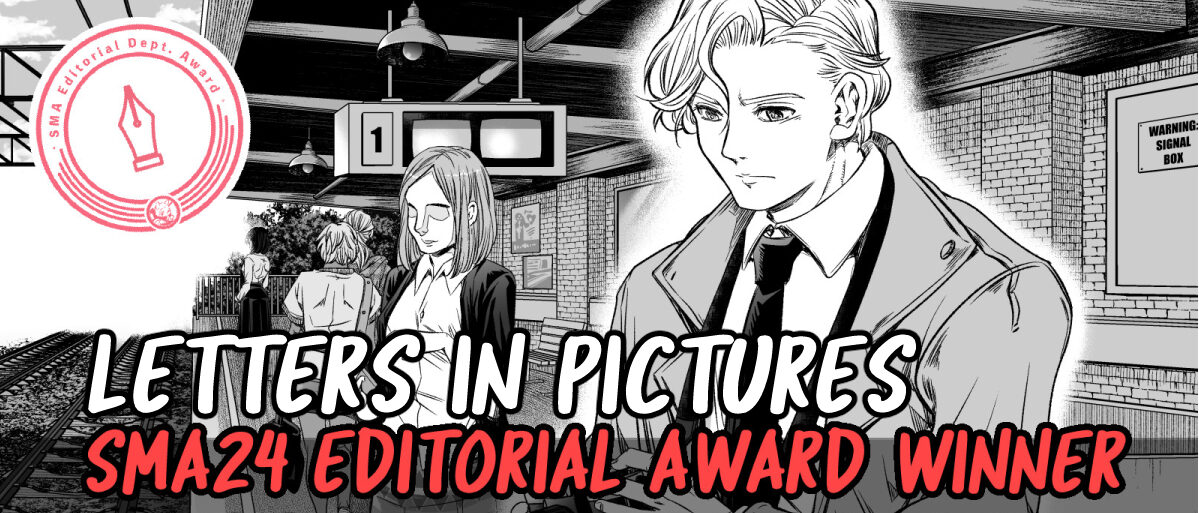
AWARDS: I won an Editorial Department Award for the Silent Manga Audition (SMA24) from Japanese publisher Coamix, where the theme was "Letters"! My story is titled "Letters in Pictures", and you can read it here, along with the other winners on the SMA24 results page, at the end of the page. Thank you for the kind words from Editor Motoda and the SMA Editorial Department, and I'm interested in entering SMA25 as well!
NEXT MANGA: With competitions all out of the way, I'm using August to get back to work and catchup on commission work I've put to the wayside. I'll restart work on "Sunset Protocol" in September, and will pencil the entire 2-vol series before I continue drawing any more finished pages. I've also discovered that IngramSpark now has a "buy direct" button which means I can directly link a buy button to IngramSpark rather than ship books myself! Wonderful! This site might see some overhaul on that front!
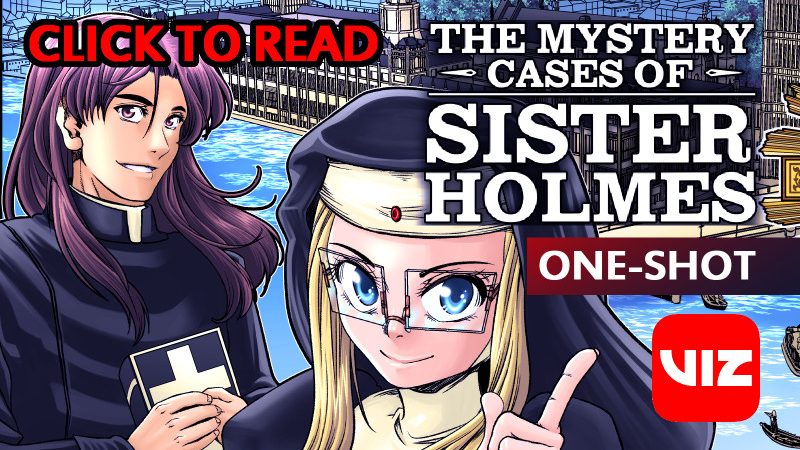
CONS: August is quiet for cons, but BookWeek is end of August so I've got some school workshops. I've got the printed version of "Sister Holmes", my Viz one-shot, and will be selling it at cons.
Well, I’ve been crocheting a lot of cool amigurumi toys lately, which I’ll show in the next few weeks, but I also finished pencils for chapter 1 (of 9) of Small Shen, my collaboration with author Kylie Chan. This is a Chinese Fantasy story and is a prequel to her White Tiger series, and people who are familiar with what I like to draw best will probably know that I’m in my element here.
I’m sure you’re all wondering what Small Shen is about, so here are a few sample pages from chapter 1. Some are inked/toned and others are still in pencils, but you can probably get a good idea of how the art will turn out from these samples. Since Small Shen won’t be out (from Harper Collins) until Christmas 2012, I’ll probably show more later on next year.
NB. And yes, if you know your Chinese mythology, I can tell you that “Gold” and “Jade” are references to the demi-semi-gods “Golden Boy” and “Jade Girl”. The story’s written by Kylie though, so if you want to know more about how she uses these characters, I suggest you read White Tiger, which is the first actual book in the series.
I’ve started on Small Shen, which should be due next year in July (probably in time for a Christmas release). We shall see how it goes! Also, I’ve got a bumblebee crochet here, from a pattern kindly placed online by the Curious Crochet blog. Isn’t it cute?
Step 1: Start making the striped body. Learned to change colours in a single crochet body here.
Step 2: Added little black eyes... these were the first beady safety eyes I bought, and I'm glad I still have a use for them.... as they were actually too small!
Step 3: Sewed the stinger on. Almost made a mess out of this, as the stinger was so small it was hard to crochet.
Step 4: Crocheted the wings, and sewed the onto the body.
Here’s a pic of the finished Bumble Bee Amigurumi:
Hi all, folks. In preparation for the release of Legend of Zeld: Skyward Sword, I’ve been doing a trip down memory lane of all the Zelda games I’ve played in the past (which is all of them). For those unfamiliar with Nintendo’s Legend of Zelda game franchise, it’s probably Nintendo’s best-selling franchise right after Mario, and one that constantly has critical acclaim heaped on it. The series first started in 1986 on the Nintendo Entertainment System, and has spawned 14 games over the past 25 years. I’ve been a fan of the games since I was 6 years old – I played the originalLegend of Zelda, though it would be years later that I finally manage to beat the last dungeon. This year is the 25th Anniversary of the Zelda franchise, and it’s apt that I choose this time to recommend what I think is the best game in the series.
Most people consider Ocarina of Time for the N64 to be the best Zelda game of all time, but I disagree. For me, that title would always go to A Link to the Past for the SNES. It’s simply the most tightly-designed, complete Zelda game of the series, though Link’s Awakening and the Oracle are also worth a mention.
Legend of Zelda: A Link to the Past (Nintendo) (1992, Super Nintendo)
A Link to the Past may have been released years ago, but due to its cartoony, stylised graphics, it has aged better than Ocarina of Time. You can still play the game today and not feel the technological limitations of the hardware. Let’s face it, as great a game as OoT was, that horrible 1st-generation 3D cannot be helped unless there’s a complete graphical overhaul of the game. New textures or not, it still looks like a bunch of blocky polygons walking around.
Plot Legend of Zelda has a very simple plot, and that plot is basically the same in nearly all the games. The story is a subversion of age-old fairytale tropes. A young lad comes to save the princess of a kingdom from an evil usurper, and when he succeeds, gets nothing more than a “Thanks”. Woah, what happened to getting married to the princess and becoming the king? Everyone knows that you shouldn’t save a kingdom from evil unless you’re going to get a big reward at the end.
To fill in the blanks, the kingdom is called Hyrule, and the princess is called Zelda – hence the title of the game. Princess Zelda is also a subversive princess – she holds the Wisdom part of a magical artifact called the Triforce, three golden triangles which are the holy relics of Hyrule. The hero is called Link, and he holds the Triforce of Courage, which enables him to journey through devious dungeons and defeat fearsome monsters in his quest to rescue Zelda. The villain is sometimes Ganondorf, a thief who has stolen the Triforce of Power. Mix and match these ingredients, and you get the basics of a Zelda game.
To date, Link has saved the world 14 times, and has never gotten anything for it, not even second billing in the title (save once). Mark of a true hero, I suppose, but it also accounts for the streak of melancholy that runs through all the games. Unlike other standard fantasy stories, there is always a sense of sadness and loss with the hero’s victory. Link may be an everyman who never talks in any of the games, but his green hat and tunic makes him probably the mostly widely-recognised and beloved character in all of video-gaming.
Why I Recommend this Game
I love Action-Adventure games, especially when they involve lots of exploring, secrets and puzzles. And the Zelda games are pretty much all of that in one neat little package – you traverse a World Map, go through multiple maze-like dungeons, collect new items/weapons, discover hidden areas, and beat up horrible monsters. I like to explore virtual worlds with varied environments, and the Zelda games have deserts, swamps, towns, glaciers, mountains, woods and rivers to explore, with plenty of side-quests and mini-games to go on. You meet all kinds of weird and interesting characters, listen to their stories, and sometimes help them find whatever it is they’re looking for. It’s like an RPG, but an action game. Why don’t they make more games like this?
I mentioned Castlevania: Symphony of the Night previously as the style of game I like, and Zelda is pretty much like that game, but with a simplier inventory screen and a top-down view instead of a side-view. Unlike Castlevania, which are nearly all action-exploration games, the Zelda games always include a fair amount of puzzle-solving, which a lot of people love. Not content with just going from place to place, room to room killing baddies? Well, try and figure how to navigate this series of corridors, collecting keys and stepping on stones that will cause previously-blocked doors to open. Not sure how to get into this particular dungeon, or this part of the map? Have a good think about it, try every action you can think of, and if all else fails, do something else for a while. Your sword not working on a particular monster? Try using some of the items in your inventory. Needless to say, there is a certain sense of satisfaction you get after solving a puzzle on your own. Some of them are deceptively simple, but that’s what makes it so brilliant – the many “Ah-hah!” moments on your first play through it.
Despite the simple graphics, the game also manages to be surprisingly atmospheric. The Super Nintendo may not have been the most sophisticated piece of hardware out there, but it has many graphical effects that made it the best game system for 2D games. From the opening sequence, when you wake up on a dark rainy night due to a telepathic call for help from Princess Zelda, to the mysterious fog of the Lost Woods, to the dark, twisted nature of the Dark World… the art style is never inconsistent, and while it can get fairly dark, it’s never truly unsettling. At its heart, the Legend of Zelda series has managed to stay PG-13 all through its life, which turns out to be a boon rather than a bane – its aging fans have stayed fans, but it’s still very successful in drawing in newer, younger fans. The same can’t be said for other game series, so eager to be seen as “adult” they forget that “being adult” has nothing to do with sex and violence.
Which brings me to the reason why I chose A Link to the Past as the best Zelda game in the series. Mind you, it has tough competition, but in the end I chose it simply because… it has the best ending. Yes, it sounds like a superficial reason for choosing a game, but the ending of a game can tell you a great deal about the course of its development. Ocarina of Time is a great game, but I can’t help but feel that the final dungeon is criminally short, whereas the final dungeon of A Link to the Past is satisfying long, with a huge boss fight at the end, and a really long ending that shows everyone who appeared in the game. ALttP is the game that I feel the developers had the time to truly polish to perfection before they shoved it out the door, and there wasn’t a single moment in the game where I wondered “Where did the rest of this go?”. Granted, the Gameboy games Link’s Awakening and the Oracle games also felt very complete, but the graphics are kinda sore on the eyes, whereas the art style of ALttP means it can can still hold up today. Which is why 13 Zelda games later, it’s still my #1 game of the series.
I’m back from NYCC and trying to recover from what was really a very long trip. Due to some mix-up with the table listing, the “Bento Comics” booth didn’t end up being listed under our name at NYAF, so I guess that may have confused a few people if they didn’t spot the “Bento Comics” booth in the Anime Festival’s artist alley, at least on the map. We did some good sales nonetheless, so better luck next time.
A shot of one of the entrances of NYCC 2011. It was crazy, with so many people going!
Here's our setup for Bento Comics. The Sherlock Holmes anthology sold very well!
The other interesting piece of news is that I’ve learned to crochet. Finally. I’ve long been a knitter, but the last time I took up crocheting was a horrible accident, so I’ve not attempted crochet since… until now. It turns out that with a few good internet instructional videos from Youtube and a bit of patience, I can crochet just fine. I fumbled the first few attempts, but I seem to be doing quite well, so well that when I crocheted a little smiley cactus, I sold it off at NYCC quite quickly.
You’ll see more crochet from me later on, but for now, I leave you with the first thing I ever crocheted. It’s “Peanut Bear” (more like Amputated Bear) from Nerdigurumi, which is a great beginner pattern (with videos). I later added arms and legs to this pink bear, so it looks a tad different now.
Step 1: Start the top of the bear with a "Magic Circle". Took me ages to get this right.
Step 2: Started making the body. By now, I can stitch increase and decrease pretty well.
Step 3: Added some plastic eyes to it. I had some left-over from my little animal knittings from earlier.
Step 4: Sewed ears onto the bear. You can also sew other ears, like dogs/cats/rabbits, which would make it a different kind of Peanut animal.
Now for the final finished, limbless Peanut Bear. Don’t worry, I DID put arms and legs on it later: