

The Waking: Interview Question

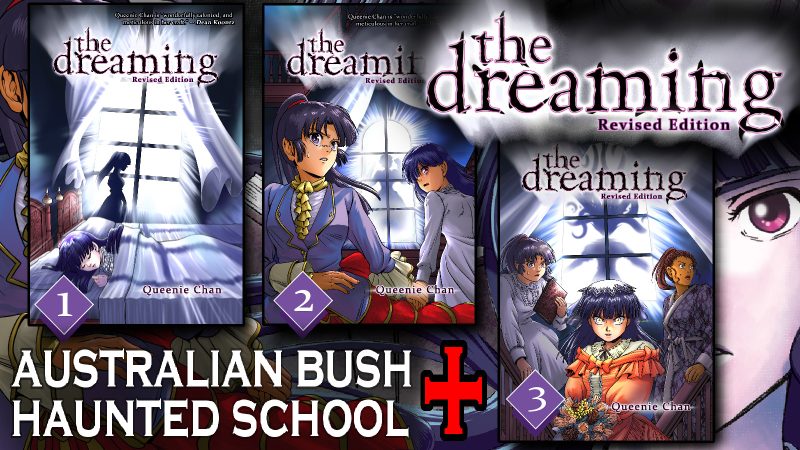
The Dreaming: Is out on the shelves, and online. I’ve still got my list of Australian bookstores up, and the latest preview chapter for the book is still up on the TOKYOPOP site. I’ve been told that “The Dreaming” has been sold out at Sydney’s Kinokuniya and Kings Comics, and that for Melbournians you can find it at Minotaur (see the list for details).

I’ve recovered from the worst of my flu, though I’ll probably have a residual cough for weeks. I also snuck some photoes of my Bangalore trip up on my LJ entry. But anyway, recently I’ve been interviewed by Kai-Ming Cha for Publisher’s Weekly Comics Week. For those who don’t know, it’s part of Publisher’s Weekly and you can subscribe to their email newsletter here. They on a one-week break so it’ll be out the week after, but it was a very fun interview and Kai-Ming asked some good questions. There is one question in particular that I replied in detail to, and which I’ve posted here for people’s interest.

As usual, it’s my opinion, so feel free to make any comments.


Question: On your website you have an essay that references the prevalence of Japanese manga throughout Asia, including Hong Kong, that has all but squeezed out local talent. There are other comments like this that have been made in countries like Thailand and China. With the strength of Japanese comics, local comics culture and style doesn’t seem to stand a chance. What are you thoughts on this?


You’ve just said my thoughts on this. *laughs* Local comics culture just doesn’t stand a chance, except for the nostalgia value of certain strips. Nostalgia does nothing though, besides recycling old material that may or may not be timeless, but if you’re not moving ahead and creating new material, you’re not expanding the readership for graphic literature. Mostly, if it can be said to be a “problem”, is that there isn’t a “manga culture” in whatever country the Japanese pop-culture juggernaut has colonised in the past 10-20 years. And it’s important to remember that manga comes attached with anime, video games, cosplay and J-pop; making it an all-consuming lifestyle that can be very appealing to young people. In theory, there’s nothing wrong with that because it should encourage said countries to develop their own comics, except that it’s not really happening.

Part of the reason is because manga that is read by children in Japan is exported and read by adults in other countries. Manga in Japan is very gender and age-conscious, so in theory, people over a certain age wouldn’t read certain kinds of manga (with exceptions ofcourse). Manga-reading Japanese adults read manga catered to their tastes, which are the sort of mature, adult-oriented (NOT meaning pornographic) manga that become best-sellers in their own right. Manga you barely see people reading overseas, because the 25 year-olds there are reading what 8 year-old Japanese kids are reading. That creates a bit of a problem in terms of choices for the 25 year-old casual manga readers who are tired of stories aimed at teenagers and want to read something more mature.

In theory, the companies can import the more mature Japanese manga and satisfy those readers, but in the Asian countries I’ve observed, it’s never really caught on. The trouble with salaryman and office lady manga, or seinen and josei manga, is that the latter appeals to more narrow, culturally-specific tastes. Teen angst and action-adventure is the same for teens everywhere, but people who have left high school don’t see salaryman manga as a reflection of their working experiences. Japan has a work culture and adult life that is culturally unique to that country, and other Asians who were casual manga readers as teenagers aren’t nearly as interested in salaryman or OL manga because from their point of view, it’s got nothing to do with their own lives. So the pool of casual manga readers shrink, leaving the young-at-heart to continue reading teen manga and riding the Japanese pop-culture wave.

This means that local comic artists are left to compete with teen manga for a readership that is adolescent at heart. None of them has been all that successful, because the Japanese do teen-oriented manga so incredibly well, and has multiple arms of the Japanese pop-culture machine helping out. There’s no reason for any local publisher to invest in local talent when they can get all the money-making franchises they need out of Japan, and they’re not interested in reaching out to older readers either. So in essence, you have a “manga culture” in manga-reading countries where unlike Japan, most readers are stuck in the “teen manga” phase. So the readership isn’t maturing at all, giving no incentive to produce mature works.


Afterthoughts: Sometimes the nationalism thing comes into it too. Some of Kaiji Kawaguchi’s work comes to mind – while it’s never stopped anyone from translating political/thriller manga in Asia, I find it uncomfortable to read manga about how the course or World War II may have been altered to have the Japanese win instead of the Allied Nations (and some such). These are clearly adult stories and not meant to be provocative to other Asian nations, but it shows a side of the nation that Chinese and Koreans particularly hate. World War II is a topic you rarely, if ever, see in shoujo and shounen manga, and perhaps for good reason.

The Waking: The Tourist

I’m back from India and really sick with the flu, though I hope to get well by the end of this week and start volume 2 by the beginning of next week. I haven’t been this sick for a long time, so I’m hoping I get well soon and back to normal. So far, there’s been no improvements – I cough so much at night I can’t get to sleep. Pure agony. Because of the flu, it was pure agony in Bangalore too, with my friend’s wedding as the sole source of solace. That said, Bangalore was alot more fun AFTER I’ve experienced it rather than before. But first, the usual news.


The Dreaming: Is out on the shelves, and online. I’ve still got my list of Australian bookstores up, and the latest preview chapter for the book is still up on the TOKYOPOP site. I hear that my book is selling pretty well at Sydney’s Kinokuniya bookstore. I wonder how it’s doing at the other stores?


3 out of 3 Postive Reviews: To list them out, they are the AnimeFringe review, the IGN Review, and the ListerX review. Thanks very much to all those reviewers, and I will post up more reviews as they come.


Bangalore: The Tourist
I won’t miss my chance to talk about Bangalore; not while I’m still in Tourist mode and recovering from the flu. The thing about travelling is that while going through a developing country on your own can have its difficulties, it’s always alot more fun in retrospect. In my instance, I’ve travelled in Vietnam and Cambodia, so developing countries don’t bother me. Once again, it’s got nothing to do with the conditions. India is actually BETTER than Vietnam and Cambodia in terms of things like shopping, but it’s the PEOPLE that get to me. I assure you, it’s not NORMAL Indians – who are perfectly nice, helpful people, but certain types of SERVICE people. Let me just say that rickshaw drivers in Bangalore drove me nuts.


Wedding

The wedding was the best part of the trip - ahhhh, finally some peace and quiet, and seeing a good friend getting hitched. She had a traditional Hindu wedding, with much chanting of prayers and Hindu rituals. Most Hindus there had no idea what was going on either, since the priests chanted in Sanskrit. The bride Sunita is in mauve. The groom Prashiba hasn't arrived yet, though he is in other pictures I have.


Kerala was real nice, and I would recommend it to others, but if you ever want to travel through a India, make sure you book a private car and a driver for the duration of the whole trip. You will be saved alot of trouble. I travelled through Kerala, Vietnam and Cambodia with these private car + tour guide arrangements, and quite frankly, I didn’t realise what a godsend it was until my group had to travel around Bangalore on our own. And THAT was what ignited my irritation with rickshaw drivers. For Bangalore had CRAZY rickshaw drivers.


Mehendi

Mehendi, a purely decorative ritual just before the 3-day wedding. It's a brown mush you apply in fancy patterns, and you wait for it to dry and wash it off. It dyes the skin a brown-red colour, and is the Indian equivalent of hen's night.


Travelling in Bangalore
It’s not that it’s hard to travel around in Bangalore. Well, actually it is. Without a private car, it’s amazingly frustrating to get around in. That wouldn’t be a problem if you were just a backpacker, and you had time on your hands. However, I was in Bangalore as a wedding guest, meaning that I had to go to 4 days of religious and pseudo-religious ceremonies, and quite frankly, we were late 99% of the time.

First of all, there are no proper maps of Bangalore. This city has road, streets and traffic lights, but no one has mapped it out properly. A map may show you the mainstreets, but none of the sidestreets, and they’re often wrong. Most people get by on landmarks, and by asking the locals where a certain place is. So that means while you can still buy a map, it won’t mean anything, because the driver of the most common form of transport, a three-seater motorbike called a rickshaw, won’t know where they’re going anyway. So while you can flag down a rickshaw almost anywhere in the city, 99% of them won’t know how to get to your destination, nor will they even know where the suburb is. And to top it all off, they drive like maniacs. I’ve been on rickshaws who go up one-way streets, with people going the correct way shouting at the driver, and another one who did two U-turns at night at a busy unlit round-about, right into the pathway of a bus who couldn’t see us.


Rickshaw

Why didn't I take a photo of an actual rickshaw? Well, here's what it's like riding in one.


Was there no better way to travel around Banglore? Sure there was. Pre-paid taxis; which are taxis belonging to certain companies with a reputation to uphold. If you go on a normal taxi, you could be driven somewhere remote and blackmailed for a large sum of money – as happened to someone else from the wedding party. You call up the pre-paid taxi company to give the origin and destination, and they normally quote the price before you go, and they even know how to get to a certain place on time. They also charge alot more than rickshaws, but at least they’re safer and more reliable.

The downside is that pre-paid taxis must be booked at least 2 hours in advance. Still, they can be an hour late, or they can charge extra money for having to wait for you (without telling you). They can’t be booked too early, as the operator told me, because they’ll forget the booking. You can book an early morning taxi the night before, but you can’t book a taxi normally for more than 5 hours before your departure time on the same day. They also have to be booked and charged for hour blocks, so if you want to book a taxi at 9:00am from A to B, and book the same taxi from B to A at 3:00pm, you’ll have to pay for that 6 hour block where they’ll just sit there and wait for you. Or you can book the morning trip, and then re-book at 1:00pm in the afternoon for the 3:00pm taxi. It didn’t seem to make any difference which pre-paid taxi company you called.

And I never got on any trains or buses – I knew I did’t stand a chance.


The Food in Bangalore
The wedding was the best part of Bangalore – it was went very smoothly. That said, India has dangerous water. If you’re careful, nothing will happen to you, but if you’re really unlucky, you may end up with a severe stomach bug and vomit up anything you eat for the whole week.


Food on leaf

Eat with right hand, unless you want to horrify everyone. We could have asked for spoons, but we wanted the authentic experience. It's not the food - rather the tap water that was used to wash the leaf before food was put on it. The food was fantastic.


The water must be bottled. You’ll probably get real sick if you drink tap water. Meat-wise, there isn’t alot to choose from. High-class joints will have great food, but I’ve noticed that there is a curious lack of meat on most menus I’ve encountered in the country. “Curious” isn’t the right word – I know mostly why – Cows are sacred to Hindus, and Pigs are unclean to Muslims. Therefore, no beef or pork on much of the menus, and you’re lucky if they have mutton in the kitchen (no matter what it says on the menu). So that leaves chicken, and if you’re low on protein, alot of egg omelettes. Protein deficiency aside, the curry is fantastic. But you’ll have to know where to find it, that’s for sure.


Shopping in Bangalore
Shopping in Bangalore is centered on and around a stretch of road called MG Road, MG for “Mahatma Gandhi”. Just about everything that can be named after someone in India is probably named after Mahatma Gandhi, and it’s no coincidence that this is the main shopping street in town. Thankfully, most rickshaw drivers know how to get there, even if they don’t know how to get back to where we stay. Intersecting MG Rd is Brigade Rd, which clearly says “Bridge Rd” on the Bangalore map, except that not a single soul in Bangalore knows where “Bridge Rd” is. Apart from that, there is also Commercial Rd, which used to be a good place to bargain, until Lonely Planet made it into a tourist strip and so therefore the last place you’ll want to bargain.

I went to Bangalore expecting new-fangled shopping malls everywhere selling cheap electronic equipment or clothing, and guess what? I’m probably shopping in the wrong district. And I really should have done my clothes shopping in Kerala, because Bangalore is much better at fleecing tourists than Kerala is. Not saying there aren’t great shopping if you know where to look – there are great discount stores that sell excellent quality stuff. Rock onto Giruja Silks on 8th Cross in Malleshwaram for great saris, and Bhavani on DVG Rd, Basavanagudi (near Gandhi markets) for anything involving jewellery. But then neither are tourist places, and can be difficult to find.


Sari shopping

Endless rows and rows of colourful cloth...


Out of all the shopping, Bhavani and general sari shopping has to be the best. Sari shopping the best of all, because here is a form of clothes shopping that involves little to no energy. You don’t even have to try anything on, because a sari is just a piece of cloth, and the skirt and blouse are bought separately and stitched by a private tailor (that’s the complicated part). For the first part, you just go to a swank sari store, sit yourself comfortably at the counter, then demand the service people to show you all the saris there are of a certain type and within a certain price range. They then will retrieve stacks and stacks of colourful cloth for you, while you go through it and pick out any you may be interested in buying. You can probably go through 50+ saris before you find about 5 you like. That’s the “correct” way to go sari shopping, according to everyone.


Hindu Temple

No photoes in Hindu temples, and no shoes either. For a foreigner like me, it was the chance to deprive me of my shoes and camera, and then make me give 2-5 rupees afterwards to get it back. In terms of experience, Hindu temples are much more photo-worthy on the outside than they are on the inside, though it was eye-opening.


Doraemon in Hindi

Doraemon on TV, in Hindi, very popular, as it is all over the world except in English-speaking countries. Along with Yu-gi-oh too - the voice acting is FANTASTIC! They sound almost exactly like their Japanese counterparts, except for Yuugi. Bollywood relies much on voice-synching, so perhaps the voice actors come from there.


Was it a good experience? Sure, I would go back (next time to Northern India). It taught me a few things about travelling TRULY without a tour guide of any sort, and how difficult it can be. Next time, I’m hiring a private tour guide and car though.


The Waking: India!

Update: I can’t believe that I’m in Bangalore, and I HAVEN’T had the time to surf the internet or even check my email. My suitcase broke down, so my priority is to buy a new QUALITY one before the Indian Airline carriers turn my broken suitcase into a thousand clothing articles on the conveyer belt. But on the bright side, there’s another positive review of “The Dreaming”, an IGN review.


Kerala (23rd November): Still at Kerala, and this time, we’re taking a 4-hour drive to see some “nature” scenery. Yesterday we went sight-seeing as well, and this time, we ran into the well-worn backpacking trail of Kerala. We visited the church where Portuguese explorer Vasco De Gama, the first European to round the Cape of Good Hope, was buried; and we also visited a place with the very politically-incorrect name of “Jew Town”. So there are Jews in India too, known as “Ohdu” in the Bible. They have a long history – dating from when the Romans sacked modern day Palestine in 70BC, and some Jews were dispersed to the India subcontinent. Most of the people running Jew Town don’t seem to be Jews though; my Indian friends actually pointed out that they look either Pakistani or Afghani. Either way, because of the backpacking trail that goes through Jew Town, they’ve pretty much turned it into a giant tourist attraction. The only signs of Jewish-ness that I see are the occasional Star of David – whereas the shops are more likely to sell Christian or Hindu memorabilia. A very incongruous mix, bu not so when you consider that Kerala is 40% Hindu, 40% Christian and 20% Muslim.


Kerala (21st November): Took a plane at noon to Kochi, Kerala, which is supposed to be tropical beach area. I got here and I don’t yet see any beaches, but there’s a reason why we’re joining a tour here. My friends have booked a 12-day tour around here for a pretty good price, which includes one night on a houseboat. I believe we’re going to roll around all the usual suspect places in Southern India, and then fly to Bangalore. Apart from that, Kochi is like a busier version of Kerala, and just about every South-East Asian city looks like this. People here stare alot too, but then I never much notice people staring at me, though my friends do. Asian girls are just unusual here, naturally.

George Washington is still having trouble finding a taker, but I’m holding out for a Western Union.


Chennai (21st November): When you find access to the Internet, use it. Here in Chennai, India, the weather is as hot as I’d expected – and it’s monsoon season, meaning that it downpours every now and then. Well, I’ve always liked hot weather, so I’m happy about it, except that so far I’ve run into several problems.

First of all, they won’t take my “old” American dollars. You supposedly can’t get Indian rupees from outside India (that’s not true, you can get it at SOME international airport money exchanges), but I took American dollars along becaus US cash is always reliable. But at Chennai International airport, the money exchange clerk looked at my money as if it were counterfeit, and promptly refused to give me rupees for George Washington. Luckily I had a few “new” ones amidst my old US cash, so I was able to get SOME rupees, but hopefully I can find a Thomas Cook exchange later on to change my money into something I can actually spend. Either that, or mooch off my friend’s credit cards.

Apart from that, all I can say about Chennai is that it’s better than Cambodia. Crossing the road here is like crossing it in Saigon/Ho Chi Minh city (you just walk across the road and trust in the people driving to not kill you). My Indian friends told me to be careful about a HUGE culture shock, but I must adapt well, because the only places where I’ve ever gotten culture shock are in first-world English-speaking countries. They also told me to expect to be ripped off, because I’m the only foreign-looking person travelling with a bunch of Indian-looking people. Oh well, I’ve been ripped off before – I can live with it.

I’m only staying in Chennai for, uh, 15 minutes more, because we’re flying down the coast to Kochi, Kerala and Trivandrum; all tropical resort places. Afterwards, we’re flying to Bangalore to attend a friend’s wedding, and coming back on the 10th December.


The Waking: To India!

India: I’m finally leaving tomorrow for India, until the 10th December. I was supposed to leave on the 17th, but just about everything that could go wrong with the preparations on this trip has gone wrong, so it’s all been delayed. Since it’s the last time I have to post news up, I’ll make sure I post something good, and a flurry of activity this week has been great. For starters, here’s an another Interview with me at “The Pulse”.


The Dreaming: This will be out in December, and the list of Australian Stores where you can buy “The Dreaming” is still here. By the time I get back, Chapter 3 will be up, but Chapter 2 is still available for November as of now. And I finally got the final version books for “The Dreaming”! I must say, I’m impressed by how it turned out. I was always afraid that the book’s tones will be printed too light, since I used Corel Photo-Paint rather than Photoshop for toning, but it turned out pretty much the same shade I wanted it to. So I’m happy with what it looks like.


The Dreaming Bonuses: Paper dolls! I drew some cute paper dolls for the book way back in August, and they’re there, as is Sarah Ferrick’s short story “Locker No. 246”. It’s a great plus to the additional material – not only does it give other artists some exposure, but it feels you’re getting more for your buck (which you are). It’s great when you don’t feel you’re getting a whole chunk of advertisements at the back. In fact, there are only TWO pages of advertisements in this book (I’m totally amazed). The entire book is 192 pages (not counting the paper dolls), so what you’re getting is effectively 190 pages of solid material. This must be the sole OEL manga release I’ve seen that has so little advertisements!


Seven Seas picks up Webcomics!: A Publisher’s Weekly article points to a great phenomenon – webcomics being considered by a book publisher! That publisher is Seven Seas, and kudos to them for also giving full rights to the creators of the webcomics as well. But my point of interest is mostly in the webcomics sphere of things. As I posed in the Engine, there are alot of bad webcomics out there, who at times can swamp the good ones in terms of sheer volume, but a book publisher taking an active interest in webcomics… it raises the legitimacy of webcomics. I would know that better than anyone, since I spent alot of my former time drawing webcomics and thinking that no publisher is going to take an interest, because I’m doing WEBCOMICS, and anyone with a web connection can do that. And somehow, through association, that kinda made webcomics “illegitimate” or something.

But now that webcomics are being given as serious a consideration as any pitch shoved under an editor’s nose at a convention (or in my case, mailed to a company)… that’s WONDERFUL NEWS!! It means that I can continue drawing the longer webcomics I have on my site, like “Keeper of the Soul”, “N.S.E.W.” and “Yuen”, which I previously stopped because I believed there was no way in hell a “REAL” publisher was going to take an interest in something that started as a webcomic. And so I started pitching to companies like TOKYOPOP, where I at least have a chance to be published in book form.

Plainly-spoken, back when I still had time to do webcomics, I considered it mostly a dead-end place where I can download my ideas, test new art styles or come up with new stories. That I didn’t mind, but thinking of the webcomics sphere as something that can be a bridge to being professionally published, rather than a freebie black-hole on the Internet, is liberating. It’ll also be encouraging for other webcomic artists, and a good place to see whether you can draw a story over the long-haul – not least because if you’re getting published, that’s exactly what you’ll have to do.

I always say that I’ll never give up drawing webcomics, and suddenly I feel I’ve been vindicated or something.


Art Overhaul: I’m starting to change my art style for my next projects again, and I find myself gravitating towards a more realistic art style. Aside from an aesthetic point of view, I find that it’s also a necessity – some of the other projects I want to work on will demand a more mature, realistic art style than what I’m currently drawing. Granted, the look of “The Dreaming” is unique, especially in the toning; it was a look specifically developed for a ghost-story set in a haunted Victorian-style school. The vast amount of greyscale toning meant that I had to forego cross-hatching, something that I really miss and is eager to get back into. Since I doubt I’ll ever do another “haunted school” story again, I doubt I’ll ever draw a story that is as heavily toned as “The Dreaming” is.


Link smiling

Here's Link again, looking rather happy. I suck ass at drawing realistic faces, so I'm doing some training in my spare time.


About moving towards a more realistic art style, this has got to do with shedding my earlier artistic influences. My earliest role models were Rumiko Takahashi (Ranma 1/2), Adatchi Mitsuru (Touch) and Watsuki Nobuhiro (Rurouni Kenshin), with Nobuhiro’s work being my “ideal” for action scenes (not that I was drawing alot of those). Granted, these artists’ work are still fantastic, but they all have something in common which I don’t want to draw anymore – namely big-eyed, anime-esque people. Their linework is simple and effective, but… hey, I like details. THAT has always been true.

Nowadays, I find myself wanting to emulate artists like Kentarou Miura (Berserk), Yoshitaka Hoshino (2001: Nights), and Kasuhiro Otomo (Akira) when it comes to action. These guys all have something in common – their artwork looks very realistic, and they have styles that are almost illustrational. Which is good for me. Granted, I’m not necessarily interested in drawing IN a realistic art style – rather, I want to be ABLE to draw realistically, so I can tell a certain type of story that isn’t as effective in a cartoony style. I can always revert back to a cartoony style, and indeed, some stories such as “Yuen” work FAR better in a simplified style than it will in a realistic one. And yet, I have serious historical, fantasy and sci-fi stories that will look alot better if told in a realistic, naturalistic form.


Saigon Art


Here’s a style that kinda straddles the borders. It was drawn rather small, so it’s missing details, but the general idea are to draw people and surroundings that will look photo-realistic. Because of that, I used a more scratchy style of inking, some cross-hatching, and dot-toning, which gives it a more roughened look. I’m afraid greyscale toning is so smooth it doesn’t make things look “real”.


Otomo Action Scene


I want to draw action like Otomo!! I got the speedlines down, but Otomo’s inking is a lot rougher in some respects. Ah well, I can’t exactly emulate Otomo anyway, so using speedlines to give a sense of motion and urgency’s good enough. It’s just practice, so what’s happening here and why, or what these guys look like ain’t important.